Our Nation's First Military Award

On June 26, 1775 General George Washington rode
into Boston to assume command the the Continental Army of the colonies soon to declare
themselves independent as the United States of America. His first impression was not
a good one. Washington had served as a Colonel in the British Army during the
French-Indian Wars, had led men and seen combat. During the march on Duquesne in
1755 his commander, Major General Edward Braddock had been killed, and Colonel Washington
was fortunate to survive. Two horses had been shot from beneath him in the action
and his uniform had been torn in four places by bullets.
Now, as the 17,000 men of his new command assembled
before him, General Washington had a deep sense of foreboding. This was no army!
He would be hard pressed to even describe it as a militia. It was a rag-tag
band of farmers, merchants, and adventurers...not a professional soldier among them.
To his good friend Patrick Henry back in Virginia he is reported to have written,
"From the day I entered upon the command of the American armies, I date my fall and
the ruin of my reputation."
In the years that followed, Washington did his best
to build them into an army. He led them by example, providing courageous inspiration
in their darkest moments. He prayed for them at night, his wife sewed clothing and
cooked meals for many of them during the harsh winter at Valley Forge. Though seldom
considered a brilliant tactician, in fact General Washington lost more battles than he
won, he was a powerful leader. Seven years later that rag-tag force was on the brink
of defeating the army of Great Britain. It was an incredible transformation.
In October of 1781 the British surrendered at Yorktown and General Washington set up his
headquarters at Newburgh, New York.
Along the way, General Washington had always tried
to maintain a degree of personal involvement with his men. He witnessed their
courage, their valor in battle, and did his best to reward them accordingly. This
was usually accomplished through "field promotions". Any soldier who
distinguished himself in battle might suddenly find himself being promoted in rank,
perhaps even receiving a commission. It was an effective recognition, for with
increased rank came increased pay.
By the summer of 1782 the American Revolution was
over, only the formalities of adopting the peace accords remained. General
Washington was in his headquarters at Newburgh, New York as the Continental Congress
reviewed the cost of the war for independence, as well as the continued cost of
maintaining an army. Funds were depleted, in fact many soldiers of the Continental
Army had not received their pay for war time service (and would not...a point which later
led to Shay's Rebellion). In a
cost-cutting measure the Congress sent General Washington a message to cease his practice
of recognizing individual achievement or valor by promotion.
Though the battle for freedom was over, General
Washington believed it was important to maintain the effectiveness and high morale of his
troops, even in peace time. As General Washington pondered this in contrast with his
recent message from Congress, he began devising new ways to recognize his men for service
and for singularly meritorious service. They were formalized in his General Orders
of August 7, 1782.
To recognized EVERY soldier for his service,
General Washington authorized a chevron to be worn on the left sleeve of any enlisted or
non-commissioned veteran who had served for three years with "bravery, fidelity and
good conduct". Veterans of six years service would be authorized to wear two
chevrons.
This was a brave new step in military history.
European models had usually recognized officers and royalty with military awards,
never the common soldier. George Washington's "badge of service" would
take emphasis away from rank, indicating that it was SERVICE and not rank that was
important. He instituted this step to recognize our first veterans of military
service by saying, "The road to glory in a patriot army and a free country is thus
open to all."
This new recognition was established with
Washington's General Orders of August 7, 1782. General Washington took it one step
further, authorizing an individual award for men who singularly performed deeds of valor
or unusual merit. It would become The Badge of Military Merit. The General's
orders described it thus:
The Badge of Military Merit
With those August 7, 1782 orders General Washington established our
first military medal, the Badge of Military Merit. It was made of cloth or silk,
purple in color and bordered with a white lace. It could be worn either suspended
from a ribbon placed around around the neck or sewn to the left breast pocket of the
uniform. The man who received it, regardless of his rank, would be granted
privileges normally reserved to officers. Specifically, any recipient of the award
would be allowed to pass by guards and sentinels with the same courtesy such other
enlisted men paid to officers.
General Washington called upon a close friend to
design the award, M. Pierre Charles L'Enfant. Later as President, George Washington
called upon that same friend to design our Nation's Capitol City in Washington, D.C.
Nearly
a year later, on May 3, 1783 General Washington presented The Badge of Military Merit to
two soldiers from Connecticut. Sergeant Elijah Churchill had been a carpenter before
entering the Continental Army as a private years earlier. He was cited for gallantry
in action at Fort St. George near Brookhaven on Long Island, at Coram, New York in
November 1780, as well as a subsequent action at Tarrytown, New York in July 1781.
Sergeant William Brown was also cited. Though records of his citation
have not been recovered, it is generally believed he was cited for his gallantry during
the siege of Yorktown.
On June 10, 1783 General Washington presented a
third Badge of Military Merit to Sergeant Daniel Bissell, Jr. A year earlier
General Washington had ordered the Connecticut sergeant to pose as a deserter, acting as a
spy among the British troops in New York. From August 14 to September 29 the brave
patriot had repeatedly risked his life to provide valuable information on enemy strength
and movement.
These three awards were all made directly by
General Washington himself, the awards presented together with a certificate detailing the
service for which the Badge was awarded. Two of these original awards are still on
display, more than 200 years after their presentation. There is no other known
record of this award.

The Medal Of Honor
General Washington's dream of recognizing
singularly meritorious action by ordinary soldiers never quite caught on. At the
time he issued his Executive Orders on August 7, 1782 he stated: "The order
(authorizing the Badge of Military Merit) to be retroactive to the earliest stages of the
war, and to be a permanent one." But Washington himself, presented only three,
and the award faded into obscurity.
Even as the Army, Navy, and Marine Corps of the
young United States became more professional, the reluctance to recognize military men
with medals ran deep. The practice of wearing medals was far too reminiscent of
European aristocracy, and the people of the United States had taken great steps to build
their nation far from the European model. In 1847 the American military found itself
committed to combat in the Mexican-American War. During that brief action a
"certificate of merit" was created to recognize those soldiers who distinguished
themselves in action. But the certificate of merit was just that, a certificate that
existed more in terms of a voucher that often brought a small payment to the soldier but
no lasting recognition or visible medal. Not until the Civil War was any
consideration given to awarding a medal itself.
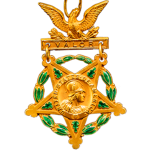
Early in the Civil War a medal of honor was
proposed in Congress to "promote efficiency in the Navy." Approved in
1861, the new Medal of Honor would only be awarded to enlisted sailors and petty officers,
and was not approved for award to commissioned officers until more than 50 years
later. The following summer the Army established its own Medal of Honor in
legislation signed by President Lincoln on July 12, 1862. Before the war ended, the
Army allowed the award of its medal to enlisted men, non-commissioned and commissioned
officers who distinguished themselves. During the Civil War more than 2,000 Medals
of Honor were awarded to United States soldiers ranging in rank from private to
general. (Later, in 1917, some 900 of these awards were rescinded.) The Navy
awarded its Medal of Honor to 308 enlisted sailors, and 17 enlisted Marines. (You
can read more specific information and chronology of the Medal of Honor HERE!) In similar fashion to General
Washington's original plan for awarding the Badge of Military Merit, the Medal of Honor
was presented by an accompanying certificate, now called a "citation", setting
forth the actions for which it was presented. An honor roll was also subsequently
established to record each recipient's name and unit for future generations.
From the end of the Civil War through World War I,
the Medal of Honor was the ONLY medal that could be earned by members of the United States
Army, Navy, Marines or Coast Guard. For this reason Medals of Honor were often
awarded in situations that, though meritorious, did not warrant such an award. As a
result, a review of Medal of Honor awards in 1917 led to the rescinding of 910 previous
awards. More importantly, it led to the creation of "lesser awards" for
actions that did not merit the Medal of Honor but were worthy of recognition. These
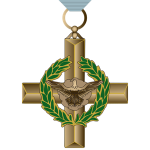
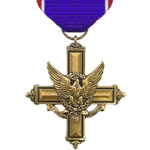
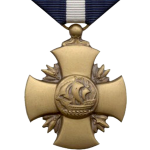
new medals including the Distinguished Service Cross (and shortly thereafter the Navy
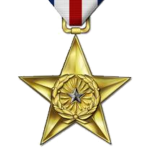
Cross) and the Silver Star, were arranged in an order of PRECEDENCE. At the top of this order of
precedence was, of course, the Medal of Honor.
Awards of the Medal of Honor in the late 1800's,
many of them to Civil War veterans for service almost half a century earlier, began to
draw attention. For the first time American military veterans began to not only
accept military medals as an American tradition, but to covet them as well. The
establishment of the Pyramid of Honor seemed to open a floodgate that, in the 50 years
following would create an array of medals for valor, medals for service, and campaign
ribbons that would be difficult to keep up with. In the process, our Nation's first
military medal began to get a second look.
The Purple Heart Medal
The award we have come to recognize as the Purple
Heart actually found its roots not so much in the desire to create a new medal for
military men to wear, as it was in the desire to honor a great American hero of the past.
George Washington was born on February 22, 1732. Nearly 200 years later the
American public was preparing for the bi-centennial of his birth, complete with
commemorative events and celebrations. In the process of researching the life
of the Father of our Country in order to plan the celebration, General Washington's
Executive Order of August 7, 1782 was found. Along with it was the record of his
purple Badge of Military Merit and the accounts of the three men who had received it.
On October 10, 1927 Army Chief of Staff, General Charles P. Summerall drafted a
bill to send to Congress in an effort to revive the Badge of Military Merit. For
whatever reasons, the bill received little support and was withdrawn early the following
year.
As the bi-centennial celebration drew closer,
General Summerall was replaced by General Douglas MacArthur, a hero of service in Mexico
and World War I, and the son of a Civil War Medal of Honor recipient. With little
public fanfare, General MacArthur began work anew on General Summerall's proposal to
re-establish the Badge of Military Merit. Throughout 1931 the Army quietly designed
and created the new award. It was announced on February 22, 1932...the 200th
anniversary of George Washington's birth. In honor of the Father of our Country and
the man who established our military's first medal, the Purple Heart would bear the
profile on George Washington on its face.
The Army quickly embraced the new medal,
authorizing its presentation to any soldier whose "wound...necessitates treatment by
a medical officer and which is received in action with an enemy." The award
itself was made retro-active, allowing World War I Army veterans who had been wounded in
action to exchange previously received Meritorious Service Citation Certificates for the
new Purple Heart Medal. In the early days of World War II, soldiers received the
Purple Heart not only for wounds, but also in some circumstances, for meritorious
service.
The Navy was not so quick to accept the Medal, and
not until a year after Pearl Harbor was it authorized for sailors and Marines. On
December 3, 1942 President Franklin D. Roosevelt issued an Executive Order authorizing the
Purple Heart to sailors and Marines wounded or killed on or after December 6, 1941.
This made all those injured or killed at Pearl Harbor eligible for the Purple Heart.
At the same time he established the Legion of Merit medal for meritorious service,
restricting the Purple Heart for award only to those killed or wounded in combat.
Later, President Truman extended the time period for the award back to April 5, 1917,
allowing Naval and Marine Corps veterans of World War I to receive the award.
Today the Purple Heart is perhaps, the
most unique of all United States military awards. Though low in the order of
precedence on the Pyramid of Honor (it ranks below the Bronze star), it is one of the most
widely recognized and respected medals. It can not be earned by courage or by
exceptional service or achievement. The Purple Heart signifies one
thing...SACRIFICE. Whenever you see the Purple Heart, know that it represents either
a combat death or a combat wound. It represents the blood that has been shed in
defense of liberty.